
Conventional Artificial Turf Reaches72°C in Indian Summers.KryoTurf™ Changes That
Conventional Artificial Turf Reaches 72°C in Indian Summers. KryoTurf™ Changes That Home / Single Post Recent Blog 20 Aug 2026 Conventional Artificial Turf Reaches72°C in Indian Summers.KryoTurf™ Changes That. 20 Aug 2026 Why Artificial Turf Gets Too Hot to Use inIndia. And What KryoTurf Does About It. 18 Aug 2026 Why Most Architectural Surfaces in IndiaFail Before Their Time. And WhatTERRALUXTM Does About It. 18 Aug 2026 The Mark That Isn't Real 18 Aug 2026 The Court in the Middle India’s urban heat problem is a climate story. But it is also a specification story. Everysurface chosen for a park, playground, housing society, or school campus is either adding to the thermal burden of the city around it — or working against it. For landscape architects, developers, and civic planners, that specification decision matters far more than the industry has acknowledged. And right now, one of the fastest-expanding surface choices across India is making that decision badly. The summer India cannot ignore In 2026, India is home to 98 of the world’s 100 hottest cities. Temperatures have crossed45°C across northern, central, and eastern India. The India Meteorological Department has issued repeated heat advisories. Hospitals are reporting rising cases of heatstroke. Children,the elderly, and outdoor workers are being advised to stay indoors during peak hours. This is not only a climate story — it is a built-environment story. Research from the IndianInstitute of Science found that Bengaluru’s built-up area rose from just 8% in 1973 to 87.6%in 2025. The Council on Energy, Environment and Water found that nearly 70% of Indiandistricts recorded at least five additional very warm nights every summer between 2012 and 2022. Nights are heating up faster than days. A city that cannot release its stored heat after dark is a city accumulating a thermal deficit that its residents pay for in health, energy costs, andquality of life. The gap between how hot Indian cities are and how hot the land around them is forms what scientists call the urban heat island effect. It is driven significantly by the materials cities are built from — concrete, asphalt, glass, and metal absorbing solar radiation during the day and releasing it slowly through the night. And increasingly, across thousands of parks, housing societies, school campuses, and sports courts across India, one material in particular is expanding this problem at pace: conventional artificial turf. The artificial turf problem: scale, heat, and what the data actually shows India’s artificial turf market was valued at approximately ₹2,800 crore (USD 337 million) in2024, according to IMARC Group. It is projected to reach ₹4,200 crore by 2033, makingIndia the fastest-growing artificial turf market in the Asia-Pacific region. At market-average installation rates, this translates to over 22 million square metres of newartificial turf installed every year — an area larger than the combined footprint of severalIndian city centres, added to urban environments annually. The cumulative installed base across India today runs into hundreds of millions of squaremetres, spread across football courts, residential podium gardens, school playgrounds,terrace gardens, urban parks, and commercial landscapes. Every one of those square metres is making a decision about heat. And in a country where urban temperatures already exceed the limits of safe outdoor activity, conventional artificialturf is making that decision in the wrong direction. What the heat data actually shows Here is the core problem: artificial turf has no evaporative cooling mechanism. Natural grasscools itself by releasing moisture through transpiration. Artificial turf has no comparableprocess. Surface evaporation from conventional turf is close to zero. Heat absorbed duringthe day has nowhere to go except outward — into the surrounding air, through the night. The data across tropical and subtropical climates directly comparable to India’s is consistent. A peer-reviewed field study conducted in Hong Kong — a humid-tropical environment at a latitude comparable to Kolkata and Chennai — found that conventional artificial turf reached surface temperatures of 72.4°C on sunny days while adjacent natural grass recorded 36.6°C. The temperature differential on the same day, in the same conditions, was nearly 36 degrees. Research published in Building and Environment found that the average hourly surfacetemperature of artificial turf under summer conditions reached 71.6°C. A field study across51 consecutive summer days in Melbourne found that conventional turf maintained adaytime mean surface temperature of 49.9°C while irrigated natural grass stayed at 29.9°C.The Melbourne study found that artificial turf consistently exceeded the 48°C skin burnthreshold for almost four hours of every single day measured. India’s climate is more demanding than Hong Kong’s or Melbourne’s. Indian cities regularlyrecord air temperatures of 40°C to 48°C in peak summer. The skin burn threshold thatMelbourne turf exceeded for four hours a day is crossed by Indian conventional turf at thestart of the morning and held through the afternoon. And it doesn’t end at the surface. A 2024 study published in Frontiers in Sustainable Citiesconfirmed that conventional artificial turf showed consistently higher temperatures thannatural grass both during the day and through the night — steadily heating the air aroundand above it. The evidence is consistent across studies and geographies. The heat contribution ofconventional artificial turf is a product of how it is engineered — not an unavoidableproperty of the material. Which means it can be engineered differently. KryoTurf™: engineered to solve the heat problem at its source KryoTurf™ by Koochie Global is the only artificial turf system in India engineered withreflective pigments infused at the fibre level — delivering surfaces up to 20°C cooler thanconventional turf under the same conditions. The distinction matters: the pigment is built into the yarn during the extrusion process, notapplied as a surface coating. It does not degrade with use or UV exposure over time. It is astructural property of the material — present from day one through the full service life of the installation. Those pigments are engineered to reflect infrared radiation rather than absorb it. Set againstthe Hong Kong tropical study data — where conventional turf reached 72.4°C while adjacentgrass recorded 36.6°C — a 20°C reduction from KryoTurf™ brings the surface temperaturemeaningfully closer to
Why Artificial Turf Gets Too Hot to Use inIndia. And What KryoTurf Does About It.
Why Artificial Turf Gets Too Hot to Use in India. And What KryoTurf Does About It Home / Single Post Recent Blog 20 Aug 2026 Conventional Artificial Turf Reaches72°C in Indian Summers.KryoTurf™ Changes That. 20 Aug 2026 Why Artificial Turf Gets Too Hot to Use inIndia. And What KryoTurf Does About It. 18 Aug 2026 Why Most Architectural Surfaces in IndiaFail Before Their Time. And WhatTERRALUXTM Does About It. 18 Aug 2026 The Mark That Isn't Real 18 Aug 2026 The Court in the Middle Artificial turf has transformed outdoor spaces across the country. But in Indian summers, it hasa problem that nobody talks about enough. It becomes too hot to stand on The Surface That Gets Left Behind in Summer Walk past any artificial turf installation in India between April and June. If it is midday, it is probably empty. Not because no one wants to use it. Because no one can. The surface temperature of conventional artificial turf under direct summer sun can exceed sixty degrees Celsius. That is not an exaggeration. That is what the science says, and it is what anyone who has tried to play on one of these surfaces in the afternoon already knows from experience. Artificial turf is, at its core, plastic. Polyethylene and polypropylene fibres that absorb solar radiation and retain heat in a way that natural grass, which cools itself through transpiration, simply does not. The result is a surface that looks like grass, performs like grass for most of the year, and then becomes unusable precisely when people most want to be outdoors — in the warm months of a long Indian summer. This is the problem that KryoTurf was built to solve. Why Conventional Turf Heats Up So Much To understand what KryoTurf does, it helps to understand what makes conventional turf so prone to overheating. The answer is in the fibres themselves. Standard artificial turf fibres are made from plastic polymers that have no particular resistance to infrared radiation — the part of sunlight that carries heat. When sunlight hits the surface, those fibres absorb the infrared radiation and convert it into heat. Because plastic does not cool through evaporation the way natural grass does, that heat has nowhere to go. It builds up. On a day when the air temperature is thirty-five degrees Celsius, the surface temperature of conventional artificial turf can be nearly double that. For a housing society playground, that means children cannot use the space in the afternoon. For a sports court, it means matches are cancelled or moved indoors. For a school, it means the outdoor space that was built for daily use sits empty through the hottest part of the day, every day, for months. The investment does not disappear. But its utility does. On a day when the air temperature is thirty-five degrees Celsius, the surface of conventional artificial turf can be nearly double that. KryoTurf keeps it up to twenty degrees cooler. That is the difference between a surface that sits empty and one that stays in play. What KryoTurf Does Differently KryoTurf by Koochie Global is not a coating applied to the surface of the turf after it is manufactured. It is a change made at the point of production, inside the fibre itself. Specialized reflective pigments are infused directly into the yarn during the extrusion process — the stage at which the raw polymer becomes the turf fibre. Those pigments are engineered to reflect infrared radiation rather than absorb it. Because the pigment is inside the yarn rather than on top of it, it does not wear off, wash away, or degrade with use. It is a structural property of the fibre, not a finishing treatment. The result is a surface that reflects significantly more solar heat than conventional artificial turf, keeping the surface temperature up to twenty degrees Celsius cooler under the same conditions. That is the difference between a surface that is unusable at noon and one that remains in active play throughout the day. What Twenty Degrees Cooler Actually Means Numbers are useful. Context is better. A conventional artificial turf surface at sixty degrees Celsius cannot be used barefoot. It causes discomfort within seconds and can cause burns within minutes. A surface that is twenty degrees cooler — at forty degrees — is still warm, but it is usable. Children can play on it. Athletes can train on it. Residents can use the space without timing their visit around the angle of the sun. The barefoot test is the most direct way to understand what KryoTurf achieves. If a child can walk across the surface without discomfort in direct summer sun, the surface is doing what outdoor infrastructure is supposed to do: serving the people who use it, at the time they want to use it, without restriction. Two Applications. One Standard KryoTurf is available in two variants, each designed for a distinct application context. KryoLandscape is designed for decorative and landscaping installations — residential gardens, terrace surfaces, playground surrounds, and communal green areas. Beyond keeping the surface cooler underfoot, KryoLandscape has a secondary thermal benefit: when installed on a terrace or roof surface, its heat-reflective properties reduce the temperature of the spaces below it as well. For buildings in high-heat urban environments, this is a meaningful reduction in cooling load. KryoSport is designed for sports court and multipurpose playing surfaces. The same reflective pigment technology is applied to a fibre specification built for the mechanical demands of daily sport use — the foot traffic, lateral movement, and surface stress that a sports court experiences over years of operation. UV-stabilised for lasting performance and built for versatile compatibility across court types and subbase specifications. Both variants carry the same engineering philosophy: a surface that performs to its full specification on the hottest day of the year, not just the days when the weather cooperates. The Broader Case for Cooler Surfaces in Indian Cities India’s urban heat challenge is well documented. Cities like Delhi, Ahmedabad,
Why Most Architectural Surfaces in IndiaFail Before Their Time. And WhatTERRALUXTM Does About It.
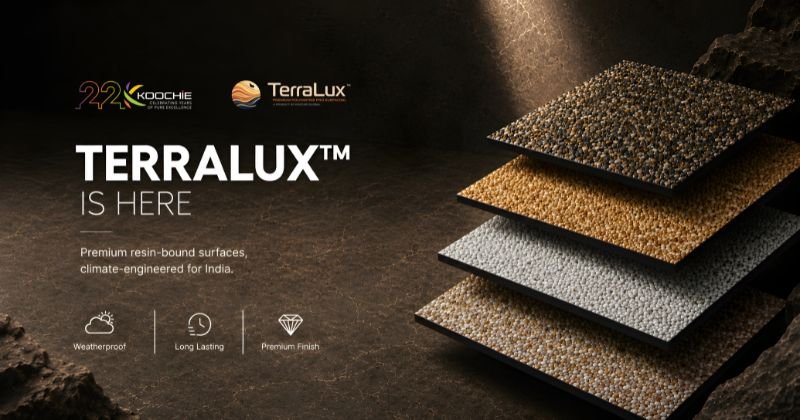
Why Most Architectural Surfaces in India Fail Before Their Time. And What TERRALUXTM Does About It Home / Single Post Recent Blog 20 Aug 2026 Conventional Artificial Turf Reaches72°C in Indian Summers.KryoTurf™ Changes That 20 Aug 2026 Why Artificial Turf Gets Too Hot to Use inIndia. And What KryoTurf Does About It. 18 Aug 2026 Why Most Architectural Surfaces in IndiaFail Before Their Time. And WhatTERRALUXTM Does About It. 18 Aug 2026 The Mark That Isn't Real 18 Aug 2026 The Court in the Middle A premium development does not end at the facade. The ground it sits on, the paths betweenits buildings, the surfaces connecting it to the world outside — these define the experience of aspace as much as anything the architect draws. In India, those surfaces have a persistentproblem the industry has stopped noticing because it has never had a real alternative The Surface Nobody Gives Enough Credit To Walk through the podium level of any premium residential development in India. Look down. The tiles are beginning to stain at the grout lines. The concrete pathway has a hairline crack running along the edge where the subbase shifted during last monsoon. The stone coping around the garden beds has turned a dull grey where the sealant has given way to UV exposure. The space looks five years older than the building it belongs to. This is not a maintenance failure. It is a specification failure. The surfaces were chosen for what they looked like on a sample board in a showroom, not for what they would face for the next twenty years in an Indian climate. And in India, what a surface faces is considerable — intense UV radiation for eight months of the year, sustained temperatures that drive ground heat well above air temperature, and monsoon cycles that test every joint, seal, and drainage specification a surface relies on. Conventional surfaces were not designed for this. Most of them were designed for European climates and imported assumptions. The gap between what they promise on installation and what they deliver five years later is the gap that TERRALUXTM was built to close. What Resin-Bound Surfacing Actually Is Resin-bound surfacing is not a coating. It is not a sealant. It is not paint applied over an existing surface. Understanding the distinction matters, because it explains why resin-bound surfaces behave differently from everything else in this category. The process begins with natural aggregate — crushed stone, gravel, marble chip, or recycled glass, depending on the specification. That aggregate is thoroughly mixed with a clear or pigmented resin binder until every particle is completely coated. The mixture is then laid and trowelled to a smooth, consistent finish. When it cures, the result is a monolithic surface in which the aggregate is fully encapsulated within the resin matrix. Nothing is loose. Nothing is sitting on top of anything else waiting to be dislodged. The surface is permeable by design. Water passes through the matrix directly to the drainage layer below, eliminating standing water, reducing runoff, and keeping the surface dry underfoot even immediately after rain. For Indian conditions — where monsoon drainage is a live engineering concern on almost every outdoor specification — this is not a minor advantage. It removes an entire category of surface failure from the equation. The aesthetic range is wide. The aggregate choice determines the final colour and texture, which means the surface can be matched to almost any architectural palette — from warm sandstone tones for heritage contexts to cool grey aggregates for contemporary development. The cost of a surface that fails — in remediation, in reputational damage, inthe visible deterioration of a space designed to impress — far exceeds thecost of specifying correctly the first time. Why Conventional Resin Systems Fail in India Resin-bound surfacing has a significant track record in European markets. The problem is that most of the formulations developed for those markets were engineered for European conditions — moderate UV exposure, temperate thermal cycling, and humidity patterns that bear little resemblance to what a surface faces in Delhi, Mumbai, or Chennai. The first failure mode is UV degradation. Resins that are not UV-stabilised yellow visibly within weeks of installation under Indian sun exposure. The discolouration is not subtle. A surface that was specified for its aesthetic quality begins to look compromised before the building it serves has been fully occupied. This is not a maintenance issue. It is a chemistry issue. The resin was not formulated to resist the UV index it is experiencing. The second failure mode is thermal stress. Indian summers drive ground temperatures significantly above air temperature. Surfaces expand under heat and contract at night. Conventional resin formulations that do not account for the thermal cycling specific to tropical climates develop stress fractures along joints and edges over time. Once the fracture appears, water infiltration accelerates the failure. The third failure mode is moisture sensitivity during installation. Resin and moisture are incompatible during curing. In India, where ambient humidity is high for much of the year and monsoon patterns can be unpredictable, conventional installation windows are narrow and the margin for error is slim. A system not designed for high-humidity installation conditions will produce clouding, bubbling, or adhesion failure — defects that are visible immediately and impossible to reverse without removing and relaying the surface. What TERRALUXTM Does Differently TERRALUXTM PolyMatrix Pro System is not a European resin system adapted for India. It is a surfacing system engineered from the specification stage for the climatic realities of the Indian subcontinent andcomparable tropical environments. The resin formulation is UV-stabilised as a baseline requirement, not an optional upgrade. The chemistry accounts for the UV index that Indian installations will face across their service life. Yellowing and discolouration are addressed at the material level, not managed through post-installation maintenance. The system is formulated for thermal stability under the temperature cycling that Indian outdoor surfaces experience — high heat during the day, significant cooling at night, and sustained thermal stress across
The Mark That Isn’t Real
The Mark That Isn’t Real Home / Single Post Recent Blog 20 Aug 2026 Conventional Artificial Turf Reaches72°C in Indian Summers.KryoTurf™ Changes That 20 Aug 2026 Why Artificial Turf Gets Too Hot to Use inIndia. And What KryoTurf Does About It. 18 Aug 2026 Why Most Architectural Surfaces in IndiaFail Before Their Time. And WhatTERRALUXTM Does About It. 18 Aug 2026 The Mark That Isn't Real 18 Aug 2026 The Court in the Middle On the small habit that lets anyone specifying outdoor infrastructure feel completely confident in what they are installing, in under two minutes A Small Mark, a Big Promise For over twenty years, Koochie Global has built outdoor infrastructure carrying certification marks thatmean something. TUV SUD. EN16630. EN1176. Each one is a promise, backed by an independent body,that the equipment being installed has actually been tested to protect the people who will use it. It is a small mark, usually printed quietly in the corner of a document. It is also one of the most reassuring things on that page, once you know how to read it. Why the World’s Certification Bodies Take This So Seriously TUV SUD, one of the world’s largest independent testing and certification bodies, maintains a dedicated program to protect the integrity of every certificate it issues. The company is a founding member of the Certification Industry against Counterfeiting, an alliance of the world’s leading certification organisations working directly with Interpol. TUV Rheinland runs a public certificate database of its own, called Certipedia, that anyone can search by scanning a QR code. These programs exist for a simple reason: the certification bodies want every buyer to be able to trust every mark completely, and they have built the infrastructure to make that possible. Real certification takes real effort. A product is sent to an accredited laboratory, tested against a specific standard, and re-tested periodically to confirm the manufacturer has kept producing to that standard. That effort is exactly why the mark carries weight. It is also why these organisations have made verification so easy, so that the value of doing things properly is always visible to anyone who takes a moment to look. The Habit That Turns a Claim Into a Certainty A certification mark is a claim. What turns it into a certainty is verification, and the good news is that verification is free, fast, and built specifically for people like the ones reading this. Both TUV SUD and TUV Rheinland maintain public certificate databases, searchable by certificate number, product name, or manufacturer, designed so that architects, school administrators, and housing societies can check for themselves in moments, rather than take a mark on faith. A certification mark is a claim. Verification is what turns it into a certainty, and it takes less than two minutes. How to Verify a Certificate in Under Two Minutes Checking a genuine certificate against one of these databases takes under two minutes. It requires no special access, no account, no relationship with the certifying body. It simply means asking for the certificate number and taking a moment to confirm it, a small step that brings real peace of mind on an installation a school or a housing society will be standing on for the next decade. A Good Question to Ask, and a Good Answer to Expect When specifying outdoor infrastructure, it helps to ask for one specific detail: the exact certificate number, and which body issued it. A supplier who takes certification seriously will have that number ready immediately, because it is simply a fact about their product they are glad to share. This is the standard every Koochie Global installation is built to meet, every certificate number tied to the project documentation handed over on completion, ready to be checked by anyone who asks, before or after installation. Confidence, Built In The overwhelming majority of manufacturers, in outdoor infrastructure as in every certified industry, take testing seriously, because a well earned reputation is worth far more than a shortcut. The dedicated, Interpol coordinated work of the world’s certification bodies is not a reason for concern. It is a sign of how seriously the industry takes protecting the people who rely on these marks, and how much infrastructure now exists to make that trust easy to confirm. The habit itself is simple and, honestly, a little satisfying. Ask for the certificate number. Look it up. See the match. It takes less time than reading this paragraph, and it turns a good feeling about a supplier into an actual certainty. This is the standard Koochie Global holds itself to on every certified installation, not paperwork for its own sake, but confidence anyone can verify for themselves, any time they like.
The Court in the Middle
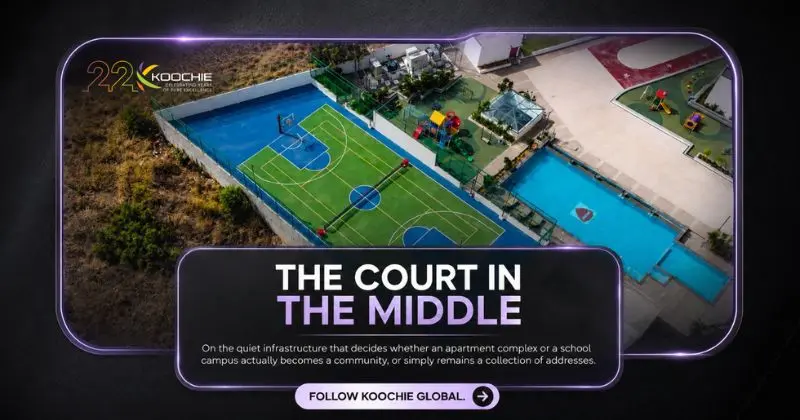
The Court in the Middle Home / Single Post Recent Blog 20 Aug 2026 Conventional Artificial Turf Reaches72°C in Indian Summers.KryoTurf™ Changes That. 20 Aug 2026 Why Artificial Turf Gets Too Hot to Use inIndia. And What KryoTurf Does About It. 18 Aug 2026 Why Most Architectural Surfaces in IndiaFail Before Their Time. And WhatTERRALUXTM Does About It. 18 Aug 2026 The Mark That Isn't Real 18 Aug 2026 The Court in the Middle On the quiet infrastructure that decides whether an apartment complex or a school campusactually becomes a community, or simply remains a collection of addresses For over twenty years, Koochie Global has been designing and installing the outdoor courts and sports spaces that sit quietly at the centre of Indian apartment complexes and school campuses, infrastructure that rarely gets discussed until the day it is missing. This piece is about that space, what it does, who uses it, and why its presence or absence shapes a community far more than most people realise. Why a Court Is Different From Every Other Amenity Walk through any apartment complex built in the last fifteen years and you will likely pass a court of some kind. A half basketball hoop bolted to a wall. A patch of tiles marked out for badminton. Sometimes a proper multi use court with painted lines for three different sports layered on top of each other. The quality of that space, and whether anyone actually uses it, tells you something about how the building was planned, and more quietly, about how the people inside it will come to know each other. A court works differently from every other shared amenity in a residential complex. A clubhouse needs a booking. A gym needs equipment maintenance and often a membership fee buried somewhere in the maintenance bill. A swimming pool needs supervision and closes for half the year. A court needs almost nothing. A ball, two people, and enough light to see by. This low barrier to entry is precisely why it becomes, over time, the place where a building’s actual social life happens. Children meet other children there before their parents ever exchange a word in the lobby. Teenagers claim it in the evening in a way they never claim the manicured garden downstairs. Retired residents walk its perimeter after dinner, sometimes stopping to watch a game they have no stake in, simply because it is the one place in the complex where something is always happening. What a Court Means on a School Campus Schools carry a different but related weight. A court on a school campus is not an amenity, it is curriculum. Physical education classes need it. Inter house competitions need it. The unstructured twenty minutes of recess, which research on child development keeps returning to as one of the more important parts of a school day, needs a surface that can survive several hundred children running across it every single day for nine months of the year. When that surface degrades, or was never built to the right specification in the first place, the twenty minutes shrinks. Children get sent to a classroom or a corridor instead, and something genuinely difficult to name, a certain kind of physical confidence that only develops through unstructured play, quietly does not develop. Two Ways to Treat the Same Square Footage What is striking is how differently this space gets treated depending on when and how a project wasconceived. In some developments, the court is clearly an afterthought, a rectangle of leftover land near the.boundary wall, surfaced with whatever material was cheapest at the time, unshaded, unlit after seven in theevening, and consequently empty for most of the day. In others, the same square footage has been treated asseriously as the lobby or the entrance facade. Proper drainage. A surface engineered to stay cool underfoot inpeak summer. Lighting that extends its useful hours well into the evening, when working residents actuallyhave time to use it. The difference in cost between these two approaches is smaller than most developersassume. The difference in how the space gets used, over a ten year period, is considerable. A court that has been engineered properly tends to age into an asset. A court thatwas an afterthought tends to age into a visible reminder that it was one. When It Goes Wrong There is a particular kind of failure that shows up often enough to be worth naming directly. A court gets built, looks reasonable in the marketing brochure, and then within two or three years the surface has cracked, the paint has faded past recognition, or the equipment has quietly rusted into something nobody wants to touch. At that point, the space does not become empty. It becomes worse than empty. It becomes a visible signal, sitting in the middle of the complex, that maintenance was not thought through beyond the ribbon cutting. Residents notice this. It changes how they perceive everything else about the building, in a way that is disproportionate to the actual size or cost of the court itself. What Happens When It’s Built Right The opposite is also true, and this is the quieter, more interesting part. A court that has been engineered properly tends to age in a way that becomes an asset rather than a liability. Three details tend to separate the two outcomes: a surface rated and certified for the load it will actually carry, drainage designed into the base rather than added as a fix, and a specification chosen for how it performs in year ten, not just how it photographs on handover day. This is the level of detail Koochie Global works to on every court it builds, whether the site is a residential complex or a school campus, because a certification on paper only means something if the surface still holds up to it a decade later. Ten years in, a properly engineered court still gets used every evening. It still hosts the same informal cricket match every Sunday morning.
Reimagining Public Fitness Infrastructure in India
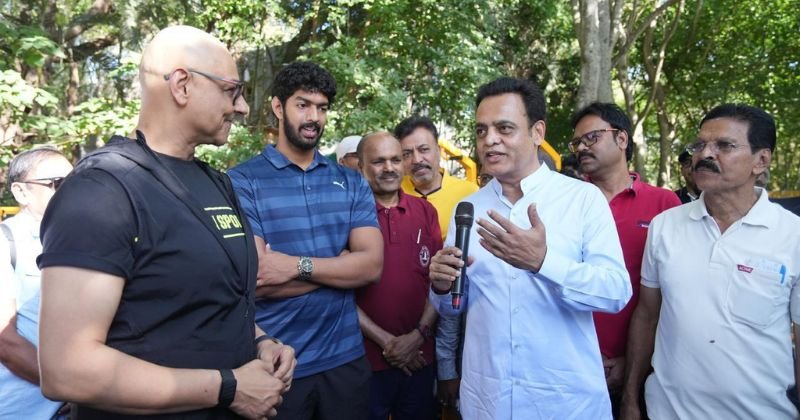
Reimagining Public Fitness Infrastructure in India Through Self Powered Innovation Home / Single Post Recent Blog 20 Aug 2026 Conventional Artificial Turf Reaches72°C in Indian Summers.KryoTurf™ Changes That. 20 Aug 2026 Why Artificial Turf Gets Too Hot to Use inIndia. And What KryoTurf Does About It. 18 Aug 2026 Why Most Architectural Surfaces in IndiaFail Before Their Time. And WhatTERRALUXTM Does About It. 18 Aug 2026 The Mark That Isn't Real 18 Aug 2026 The Court in the Middle The Sankey Tank project was enabled through the efforts of Bangalore West City Corporation. It was inaugurated by C. N. Ashwath Narayan, with the facility formally unveiled by Srihari Nataraj. The initiative stands as a compelling demonstration of how governance, technology, and sport can converge seamlessly. It is not a conventional park installation. The Sankey Tank project represents a new category of infrastructure that integrates fitness with urban planning, public health, andcommunity development. Transitioning from Installations to Self Sustaining Systems Historically, outdoor fitness installations in India have remained relatively basic, characterized by static provisions with limited adaptability and minimal technological sophistication. The Sankey Tank project transforms this landscape through the Krypton Cardio Series. This system is driven by kinetic energy generated through human activity, eliminating the need for electricity, batteries, or solar power. As a result, the infrastructure sustains itself through user engagement, establishing a regenerativeecosystem. The integrated digital consoles provide real time performance insights, including calories expended, distance covered, and workout duration. The system further adapts dynamically to user intensity, ensuring a responsive and personalized experience. This evolution redefines the user’s role, shifting from passive usage to active participation within the system. Expanding Access to High Quality Fitness Access to advanced fitness infrastructure has traditionally been limited to individuals with access to private indoor gym facilities. The Titan Strength Series addresses this gap by introducing a comprehensive strength training ecosystem within an open and publicly accessible environment. Engineered for precision, durability, and sustained usage, the system mirrors the experience of indoor gym environments while remaining accessible to all. The integration of Krypton and Titan systems creates a cohesive outdoor fitness ecosystem. Public spaces are thereby redefined as environments that support both wellness and performance, extending beyond conventional recreational use. A Framework for Urban Development The Sankey Tank project extends beyond fitness into the broader context of urban development.It demonstrates the viability of infrastructure that is energy independent, scalable, cost efficient, and aligned with public health priorities. This model holds relevance across multiple stakeholders. Landscape architects can incorporate such systems into spatial design strategies. Real estate developers can enhance project value and livability. Government authorities can deploy sustainable and low maintenance solutions. Organizations can leverage such initiatives to create meaningfulcommunity impact. National Expansion Strategy Koochie Global has outlined a phased expansion plan to extend this model across India. The first phase targets deployment across 500 parks, followed by expansion to 1000 parks in the subsequent phase.The objective is to establish a network of high quality, self powered fitness infrastructure across urban centers. This initiative aims to enhance accessibility, sustainability, and community engagement, while supporting broader priorities such as preventive healthcare and improved urban livability. Leadership Perspective and Future Outlook Roben Dass, Chairman of Koochie Global, emphasizes that public infrastructure must evolve beyond accessibility to incorporate sustainability, inclusivity, and adaptability. The Sankey Tank project exemplifies this vision by enabling communities to engage with fitness through systems that are environmentally conscious and independent of conventional energy sources. It reflects a broader transformation in the role of public spaces, shifting from passive recreational areas to active, health focused community ecosystems. Through the integration of self powered fitness infrastructure, the project establishes a new benchmark for urban development in India. It demonstrates the potential ofaligning governance, technology, and innovation to create meaningful and lasting impact. The Sankey Tank project is not solely about fitness. It represents a forward looking approach to how cities can evolve in a sustainable and inclusive manner. It stands as a significant step in India’s urban development journey, with the potential to influence future infrastructure models.The Sankey Tank project, along with the Krypton and Titan systems, illustrates how public spaces can be made more accessible, sustainable, and impactful. It highlights the role of technology and innovation in shaping communities that are healthier, more engaged, and better equipped for the future.
Why the Same SteelRusts in One Parkand Not Another
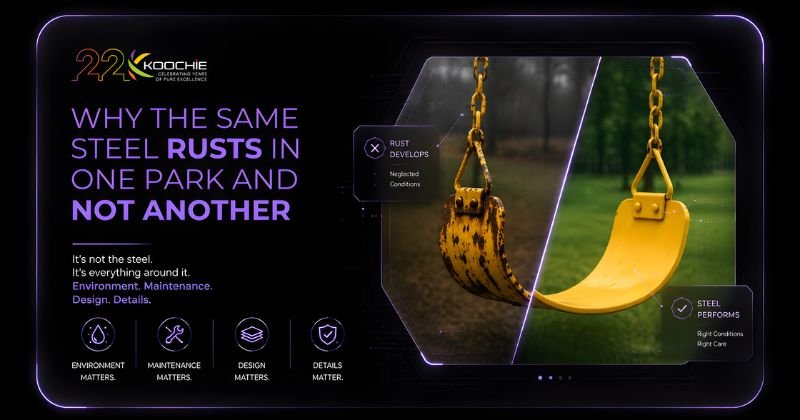
Why the Same Steel Rusts in One Park and Not Another Home / Single Post Recent Blog 20 Aug 2026 Conventional Artificial Turf Reaches72°C in Indian Summers.KryoTurf™ Changes That 20 Aug 2026 Why Artificial Turf Gets Too Hot to Use inIndia. And What KryoTurf Does About It. 18 Aug 2026 Why Most Architectural Surfaces in IndiaFail Before Their Time. And WhatTERRALUXTM Does About It. 18 Aug 2026 The Mark That Isn't Real 18 Aug 2026 The Court in the Middle On what separates outdoor installations that hold their finish for a decade fromthose that start turning to rust before the second monsoon. 01 Two Parks, One Question Picture two public parks in the same city. Both installed outdoor fitness equipment around the sametime. Both sit under the same sun, take the same monsoon, see roughly the same foot traffic.Walk through one today and the equipment looks the way it did on installation day. Walk through the other and the frames have gone the colour of rust, the joints have started to seize, and a few pieces have quietly been fenced off. Same climate. Same years. Same category of equipment. Different outcome entirely. The question worth answering is a straightforward one: what separated the twoparks was never the weather. It was what happened inside a factory, long beforeeither installation reached its site. 02 Why Most of the Market Skips This Step Hot dip galvanisation, the process that actually prevents corrosion in outdoor steel, is still described by industry researchers in India as a practice of growing awareness rather than universal adoption. In plain terms, a meaningful share of the outdoor equipment market still does not do it as standard.The reason is straightforward. Hot dip galvanisation takes longer, costs more, and requires access to a proper galvanising plant rather than a simple paint line. In a cost-competitive market, it is one of the easiest steps to quietly skip, or to replace with a thinner, cheaper coating that looks identical on the day of installation and fails within a couple of years. T H E K O O C H I E S TA N D A R D At Koochie Global, hot dip galvanisation is not an upgrade or an optional line item. It is a foundationalstep in every installation we build, followed by a full powder coating system, and certified to TUV SUDand EN 16630 standards.Over twenty-two years and across 23 locations worldwide, this process has not changed, because theoutcome it produces has never needed to. The park that still looks the way it did on day one is the onewhere this step was never treated as optional. 03 The Myth of Inevitable Rust Most people have seen it happen. A swing set, a railing, a piece of park equipment, slowly turning orange within a year or two. So the assumption feels fair. Metal outdoors equals rust, eventually.But rust is not a rule. It is a result of specific choices made long before the equipment ever reaches a park. The two parks above did not have different weather. They had different steel, prepared differently, before either installation ever left the factory. 04 What Actually Separates Them Three things determine whether outdoor equipment corrodes. The grade of steel used. Whether it goes through hot dip galvanisation. And the quality of the powder coating applied on top. Hot dip galvanisation is the step that does the real work. The steel is submerged in molten zinc, which bonds to the surface and creates a layer that corrodes in the steel’s place. It is, in a literal sense, a sacrificial layer. As long as it is intact, the steel underneath stays protected, even where the surface gets scratched or chipped. Powder coating goes on after that, sealing out moisture and UV exposure, and giving the surface its finished colour. Skip the galvanisation and coat raw or poorly prepared steel directly, and the coating is only ever as good as what is underneath it. The first scratch becomes the first rust spot. Skip any one of these three steps, and rust becomes a matter of when, not if. Theweather was never the variable. 05 Koochie’s Preventative Process Every installation, every time. 01 Steel selection Structural-grade steel specified for outdoor load and climate exposure. 02 Surface preparation Full sandblasting to remove mill scale and contaminants. 03 Flow coating Anti-corrosion primer applied before galvanisation. 04 Hot dip galvanisation Full submersion in molten zinc. Sacrificial layer formed. 05 Powder coating AkzoNobel Interpon system applied for UV resistance, colour retention, and moisture seal. 06 Certification Every unit tested to TUV SUD and EN 16630 standards before dispatch. 07 After-installation Maintenance guidance protocol and periodic check-in schedule delivered to the client. 06 How to Actually Tell the Difference None of this is visible from a distance on day one. Both parks, freshly installed, look identical. The difference only shows up two or three years in, which is precisely why it matters to ask about it before installation, not after. T W O Q U E S T I O N S T H AT D O M O S T O F T H E W O R K 1 Is the steel hot dip galvanised, not just painted or coated directly?2 Is the equipment certified to an international outdoor durability standard, such as EN 16630,which specifically tests for exactly this kind of long-term exposure? A supplier confident in their process will answer both without hesitation. Koochie Global does both. Every installation is hot dip galvanised and EN 16630 certified. These are not selective claims applied to a premium range. They are the standard specification across every project we deliver, from a single-unit park installation to a multi-phase residential development. 07 The Two Parks, Revisited Next time you walk past outdoor equipment that has held its finish for years, it was not luck, and it was not the weather being kind to one park and unkind to another. It was a decision made in a factory, long before either park ever
Why Budget Corners Cut on Surfacing Materials Cost 3x in Replacements
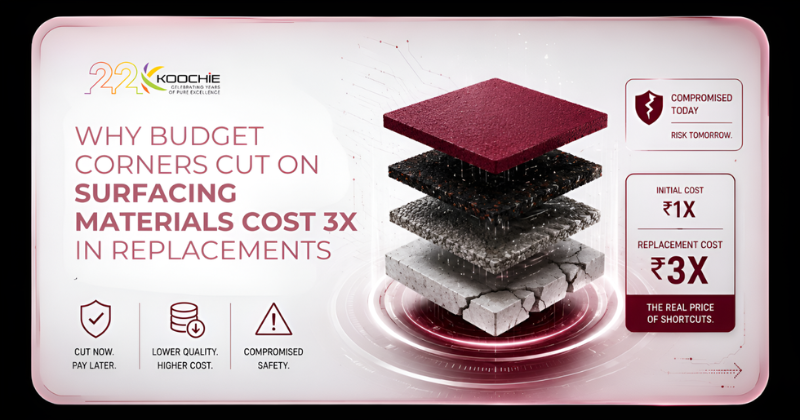
Why Budget Corners Cut on Surfacing Materials Cost 3x in Replacements Home / Single Post Recent Blog 20 Aug 2026 Conventional Artificial Turf Reaches72°C in Indian Summers.KryoTurf™ Changes That 20 Aug 2026 Why Artificial Turf Gets Too Hot to Use inIndia. And What KryoTurf Does About It. 18 Aug 2026 Why Most Architectural Surfaces in IndiaFail Before Their Time. And WhatTERRALUXTM Does About It. 18 Aug 2026 The Mark That Isn't Real 18 Aug 2026 The Court in the Middle How the wrong surfacing decision at the procurement stage leads to premature failure, higher replacement costs, and avoidable liability — and how to get it right the first time The Number That Looks Too Good It starts with a procurement table. The premium safety surfacing option sits at one price. The budget alternative sits 35 to 40 percent below it. At handover, the two surfaces look identical. The colour is right, the texture is right, and the client has just saved roughly a third of the total surfacing budget. On paper, it is the rational choice. But surfaces are not paper. Understanding what sits beneath that price difference is the first step toward making a specification decision that holds up over the actual life of the installation. At Koochie, every surfacing project begins with a lifecycle assessment, not a unit cost comparison. Our specification process accounts for climate exposure, usage intensity, and certification compliance from the first conversation — because the right call at this stage determines everything that follows. What Happens Beneath the Surface Within the first twelve to eighteen months, UV exposure begins breaking down polymer binders inside cheaper surfacing materials. UV stabilisers are a cost adder, and they are often removed during formulation to hit a lower price point. Without them, the surface begins to change. Water retention increases because the drainage compound was not premium grade. Pockets form from uneven settling beneath the surface layer. Here is what to look for:• Surface becomes tacky in sustained heat and brittle when temperatures drop• Drainage slows visibly after the second monsoon cycle• Maintenance costs spike to 150–200% of what was originally budgeted• Unplanned service calls become the new baseline spend Koochie’s EPDM surfacing systems are formulated with UV-stabilised polymer binders and premium drainage compounds as standard. These are not upgrades. They are built into the base specificationbecause we have seen what happens when they are not. Year Three: When the Real Cost Arrives By the third year, a budget surface typically falls below impact attenuation standards. EN 1177 compliance slips. This is not cosmetic — it is a liability issue. If a child is injured on a surface that has fallen below certification thresholds, the site owner is defending a known degraded surface, not anaccident on a compliant one. At this point, replacement follows a predictable sequence:• Full removal and disposal adds 15–20% on top of the replacement cost• New installation goes in at full premium price — there is no budget option the second time• Court or playground offline for 4–6 weeks during the work• Residential societies face access loss and resident complaints; commercial sites face revenue loss Every Koochie surfacing installation is EN 1177 certified and tested by TUV. Our post-installation support includes a maintenance guidance protocol and periodic check-in schedule — because certification compliance is not a one-time event. It is a condition that must be maintained, and we helpour clients maintain it. The Lifecycle Arithmetic When the total cost is tallied over a five-year window, the budget path consistently costs 180 to 220 percent of what the premium path would have cost. The premium path spreads its investment over eight to ten years of reliable, certified performance with minimal unplanned maintenance. The comparison in simple terms:• Budget path: 35% savings upfront → accelerated maintenance from year one → full replacementby year 3–4 → total spend: 180–220% of premium• Premium path: full cost upfront → minimal maintenance through year 8–10 → no replacementcycle → total spend: 100% (baseline) This is the arithmetic we walk every client through before the specification is finalised. At Koochie, we present lifecycle cost per year of reliable use, not unit cost per square metre, because that is thenumber that determines whether the investment holds. The Costs That Do Not Appear on Any Invoice Beyond the replacement cost itself, four other costs compound when a surface degrades prematurely:• Certification drift: Safety certifications lapse once the surface falls below standard. The siteowner absorbs the liability gap.• Insurance ambiguity: Claims become contested when the insurer discovers the surface was not maintained to its certified specification.• Contractor disputes: The installer says it was not maintained. The site owner says the materialfailed. Neither side resolves quickly. • Reputation: Resident complaints or user injuries create damage that no replacement invoice covers. Koochie’s client engagement extends beyond the scope of the project specifically to address these risks. Our after-sales support includes maintenance guidance documentation, certification renewal advisory, and a direct line to our technical team for the life of the installation — not just the warranty period. Why Material Composition Matters More Than Price Material composition creates a 300 to 500 percent performance gap over the lifecycle of a safetysurface. The variables that drive this gap are specific and testable: • Recycled content does not perform like virgin polymer under sustained UV and thermal cycling• Binder ratios determine lifespan — cheaper formulations use higher filler content with lower binderconcentration• Climate stress (sustained heat, monsoon humidity, coastal salt air) accelerates degradation inways that temperate-climate spec sheets do not account for Koochie’s EPDM surfacing materials are specified for Indian climate conditions from the outset. Our formulations are tested for performance at temperatures up to 55°C and humidity levels up to 99%,because a surface tested in a European lab at 25 degrees and deployed on a Bangalore rooftop at 48 is not the same product. We close that gap at the specification stage, not after failure. Getting It Right from Day One The shift happens when the conversation moves
Accident or Negligence? Why Your Choice ofSafety Surfacing Decides Which One It Is
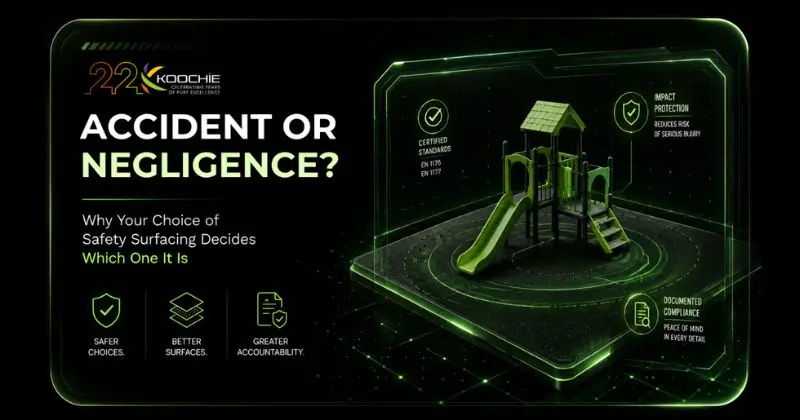
Accident or Negligence? Why Your Choice of Safety Surfacing Decides Which One It Is Home / Single Post Recent Blog 20 Aug 2026 Conventional Artificial Turf Reaches72°C in Indian Summers.KryoTurf™ Changes That 20 Aug 2026 Why Artificial Turf Gets Too Hot to Use inIndia. And What KryoTurf Does About It. 18 Aug 2026 Why Most Architectural Surfaces in IndiaFail Before Their Time. And WhatTERRALUXTM Does About It. 18 Aug 2026 The Mark That Isn't Real 18 Aug 2026 The Court in the Middle On the line between an accident where all measures were in place and a liability event where thematerial was never specified to protect in the first place — and why EPDM surfacing is where that line gets drawn. Two Falls, Two Outcomes A child falls from a climbing structure in a residential playground. In one scenario, the surface beneaththem is EN 1177-certified EPDM safety flooring, installed to the correct depth, with verified impactattenuation within published thresholds. The child is shaken, perhaps bruised, but the surfaceperformed exactly as it was designed to. The fall was an accident. The surface did its job.In the other scenario, the surface is a budget alternative — thinner, uncertified, installed without impacttesting. The same fall results in a more severe injury. The surface did not attenuate the impact becauseit was never specified to. An investigation follows. The question is no longer whether the child fell. Thequestion is whether the entity that approved the surface exercised due diligence in selecting it.The first scenario is an accident. The second is negligence. The difference between them is not the fall.It is the specification decision made months or years before the fall ever happened. An accident is what happens when every reasonable measure was in place and something still went wrong. Negligence is what happens when the measure was never in place to begin with What EPDM Safety Surfacing Actually Does EPDM — ethylene propylene diene monomer — rubber safety surfacing is the material specifically engineered to arrest falls beneath play equipment. Its function is singular and non-negotiable: absorb the energy of a child’s fall and reduce the severity of impact to within survivable, non-critical thresholds. EN 1177, the international standard for impact-absorbing playground surfacing, exists to test exactly this property — the Critical Fall Height (CFH) at which the surface can prevent a life-threatening head injury. When EPDM surfacing is correctly specified, installed to the right depth, and certified to EN 1177, itcreates a documented, testable, defensible safety layer beneath every piece of equipment. Thatdocumentation is what separates an accident from a liability event in any post-incident investigation.At Koochie, every EPDM surfacing installation is EN 1177 certified and tested by TUV. The depth iscalculated against the Critical Fall Height of the specific equipment it sits beneath — not applied as auniform layer. This is the level of specification rigour that holds up under scrutiny, because it was designed to. Where the Budget Decision Creates Liability Most budget surfacing alternatives look identical to certified EPDM on the day of installation. The colour is right, the texture is close, and the cost is 35 to 40 percent lower. The procurement table tells a compelling story. What it does not tell you is:• Whether the material has been tested to EN 1177 for impact attenuation at the installed depth• Whether the polymer binders include UV stabilisers rated for Indian climate exposure• Whether the drainage substrate will hold its structure through monsoon cycles• Whether the surface will still meet its original impact performance at year two, let alone year five Within twelve to eighteen months, uncertified surfaces begin to degrade. They turn tacky in heat, brittlein cold. The impact-absorbing properties diminish as the binder breaks down. By year three, the surface no longer performs to any published safety threshold. If a fall occurs at that point, the entity that approved the surface is not defending an accident. It is defending a material choice. Koochie’s EPDM specification process eliminates this exposure from the outset. Our formulations are tested for performance at temperatures up to 55°C and humidity levels up to 99%, because a surface specified for European conditions and deployed in Indian climate is a liability waiting to materialise. The Liability Arithmetic The cost comparison between certified EPDM and budget surfacing is not a savings calculation. It is arisk transfer.• Certified EPDM (EN 1177): Full cost upfront → documented impact performance → defensible inany investigation → liability sits with the accident, not the specification• Uncertified budget surface: 35% savings upfront → unverified impact performance →indefensible if degradation is proven → liability sits with the specifier, the approver, and the installerWhen the total cost is tallied, the budget path consistently costs 180 to 220 percent of what the certified path would have cost — and that is before any legal or insurance exposure is factored in. With it, the cost becomes unquantifiable.At Koochie, we walk every client through this arithmetic before the specification is finalised. We present lifecycle cost per year of certified, defensible performance — not unit cost per square metre — because that is the number that determines whether the investment protects the client as much as it protects the child. The Costs That Follow Negligence When a surface fails and an injury occurs, the replacement invoice is only the visible cost. Four other liabilities compound beneath it:• Certification void: A surface that was never certified, or that has fallen below its certifiedthreshold, offers no documentation in a dispute. The site owner absorbs the full liability gap.• Insurance challenge: Claims become contested when the insurer discovers the surface was notinstalled or maintained to a published standard. Coverage may be denied.• Contractor exposure: The installer says it was not maintained. The developer says the material failed. Without EN 1177 certification as a baseline, there is no objective standard to adjudicate against.• Reputational damage: A child injured on a surface that was never specified to protect them is not a story about an accident. It is a story about a